Genealogy Begins with Documents, but Memory Gives Them Meaning
The value of memory in genealogy becomes clear when we move beyond certificates and begin reconstructing historical context, migration, and lived experience.
Every genealogical journey begins with documentation. Birth certificates, marriage acts, parish registers, civil records and census lists provide the structural foundation upon which research is built. Without them, genealogy would collapse into speculation. Dates, places, parentage and occupations create the skeleton of a family tree and ensure that lineage is demonstrable rather than imagined.
Yet documentation alone does not preserve memory. A certificate confirms that a person existed at a specific time and in a specific place, but it does not explain the conditions that shaped that life. It does not describe the economic pressures that influenced decisions, the cultural expectations that governed behavior, or the social hierarchies that limited or enabled opportunity. When genealogy remains confined to documentation, it risks becoming an administrative exercise. When it moves beyond documentation, it becomes an inquiry into lived experience. This is precisely where the value of memory in genealogy begins to emerge.
The Difference Between Record and Memory in Family History
A civil birth record tells us that a child was born to certain parents and may include the father’s profession. However, the profession itself only gains meaning when examined within its historical framework. Being a landowner in one region could imply stability and local authority, while being a sharecropper in another might reflect economic vulnerability. Literacy levels, property ownership, social networks and religious affiliation all shaped how individuals navigated their communities. In practical terms, the value of memory in genealogy becomes evident when we stop reading documents as isolated facts and begin interpreting them as evidence of lived experience.

The sociologist Maurice Halbwachs argued that memory is constructed within social frameworks. Individuals remember as members of communities whose structures influence what is preserved and how it is interpreted. Applied to genealogy, this means that a document detached from its social context remains incomplete. Memory begins when the document is reintegrated into the economic, political and cultural environment that produced it. Understanding the value of memory in genealogy requires placing every document within its social, economic, and historical framework.
How Family Memory Erodes Across Generations
Family memory rarely disappears suddenly. It erodes gradually. The first generation transmits stories with emotional clarity. The second generation preserves selected fragments. The third generation often retains only broad references to a country or region. By the fourth generation, precise knowledge may be replaced by approximation or silence.
Migration accelerates this erosion. Surnames are simplified, pronunciations altered and dialects abandoned. Specific villages become generalized national identities. Historical circumstances that once shaped daily life are reduced to vague explanations such as “they left for a better life.” Over time, context dissolves and what remains is a lineage stripped of depth.
Genealogical research has the capacity to reverse this process, but only when it seeks reconstruction rather than accumulation. Collecting certificates does not automatically restore memory. Interpreting them within their historical framework does. Without contextual reconstruction, the value of memory in genealogy risks being reduced to a purely technical exercise.
Places of Memory and the Reconstruction of Identity
The historian Pierre Nora introduced the concept of “places of memory,” arguing that when living traditions weaken, societies rely on symbolic anchors to preserve identity. In genealogy, these anchors are often embedded in archival material. A parish that appears consistently across generations, a recurring given name, a family property referenced in multiple notarial acts or a military record marking compulsory service can all function as stabilizing points in a fragmented narrative.
When these elements are connected, they form continuity. Continuity transforms a list of ancestors into a coherent family history. Identity emerges not from isolated records, but from patterns sustained across time.
Migration and Historical Forces: Restoring Context to Ancestral Decisions
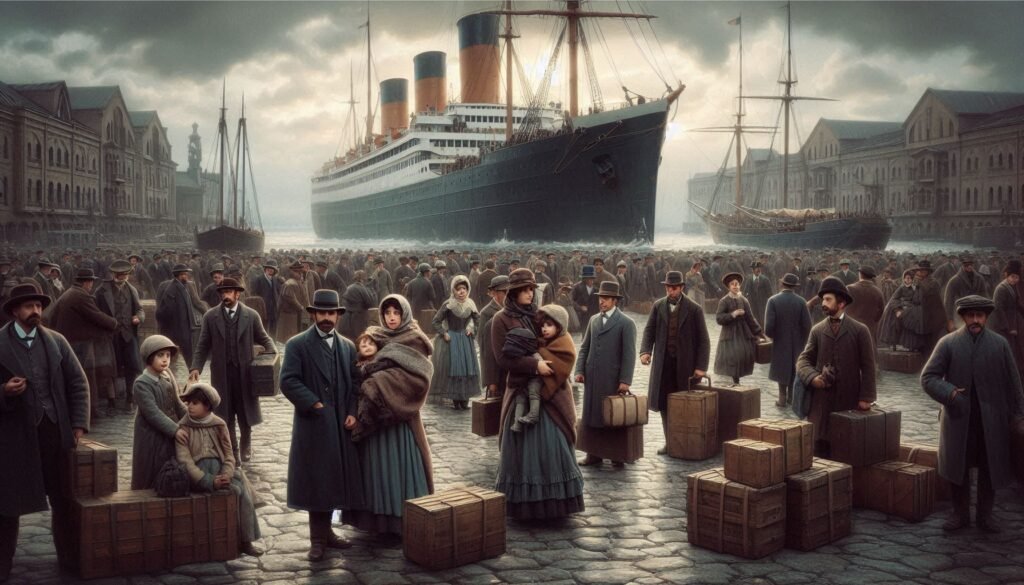
When an ancestor emigrated during the late nineteenth or early twentieth century, that decision was shaped by historical forces. Agricultural crises, land fragmentation, taxation policies, industrial expansion abroad and compulsory military service influenced mobility patterns across Europe. Without examining these structural factors, migration appears as an individual act detached from circumstance. Examining migration patterns in this way reinforces the value of memory in genealogy, because departure is rarely just a geographic movement but a response to historical pressure.
Placing migration within its historical context restores proportional understanding. It clarifies that departure was often a rational response to economic or political pressure. Descendants who understand these pressures gain insight into the resilience and constraints that shaped their family trajectory.
Genealogy therefore intersects with social history. It connects personal lineage to broader transformations and reveals how global processes were experienced at the level of individual lives.
Reconstructing Memory: The Case of a Mantuan Performer in South America
To understand what it means to move beyond documentation, it is useful to consider a concrete example. This example clearly illustrates the value of memory in genealogy, because only by expanding the research to newspapers and performance archives could his real story emerge.
During one research project, I encountered the name of a singer from the province of Mantua in northern Italy. In the civil records, he appeared as many others do: born in a small town, married, later widowed. At first glance, nothing distinguished him from hundreds of similar entries.

The turning point came after the death of his wife. Shortly afterward, he left Italy.
If the research had stopped at civil records, the narrative would have been simple: a widower emigrated.
But deeper investigation revealed something far more complex.
By consulting historical newspapers in Argentina and Brazil, I was able to trace his presence in theatrical programs and entertainment columns. His name appeared in advertisements for performances, in reviews of variety shows, and in touring announcements. He was not simply an emigrant laborer seeking agricultural or industrial work. He was a performer who rebuilt his life through spectacle.
Local newspapers described his appearances in cafés, theaters, and traveling companies. In some cases, short commentaries mentioned the reception of his performances and the cities he visited. Through these fragments, a different portrait emerged: not a man who disappeared into anonymity, but someone who entered a transnational circuit of entertainment at the turn of the twentieth century.

This transformation is precisely where memory begins to take shape.
The civil record had documented his birth and marriage. The death record had confirmed his loss. Passenger lists had recorded his departure. But only the newspapers restored his voice and presence within a social and cultural environment.
He was no longer a widower who emigrated. He was a Mantuan artist navigating grief, migration, and opportunity in a new continent, performing for audiences who read his name in print.
Without consulting period newspapers, this dimension would have remained invisible.
Why This Matters for Genealogical Research
This case illustrates a fundamental principle of serious genealogy: individuals rarely fit into predictable categories. Migration does not always mean agricultural labor. Loss does not always result in retreat. Reinvention is often part of the story.
When research expands beyond civil and parish registers to include newspapers, theatrical archives, immigration records, and local press, it restores complexity.
In this case, entertainment columns in Argentine and Brazilian newspapers functioned as unexpected archives of memory. They preserved traces of mobility, professional identity, and public presence that official documents never recorded.
Genealogy, when practiced at this level, is no longer the recovery of lineage alone. It becomes the reconstruction of lived experience across borders.
Archives as Cultural Memory
Archives are frequently perceived as bureaucratic repositories. In reality, they are instruments of cultural preservation. They capture social organization, legal frameworks, economic relations and community structures. When we consult parish registers or civil ledgers, we access not merely administrative data but fragments of collective memory preserved through institutional continuity. Recognizing archives as repositories of collective memory strengthens the value of memory in genealogy and transforms research into cultural reconstruction.

Recognizing this dimension changes the approach to research. The document is no longer an isolated proof; it becomes part of a wider cultural narrative. Genealogy gains depth when it acknowledges the archival record as both evidence and memory.
Oral Memory and Documentary Evidence
Family narratives are invaluable but complex. Oral memory is shaped by emotion, selective emphasis and generational reinterpretation. Events may be compressed, magnified or omitted. Rather than dismissing oral history as unreliable, serious genealogical research integrates it critically. Documentary evidence stabilizes family stories, while oral testimony directs attention to areas requiring investigation.
Memory and documentation are not opposites. They operate together. The document anchors memory in evidence, and memory provides direction and meaning to documentary research.
Beyond Legal Proof: Restoring Dimension and Dignity
For many individuals, genealogy begins with legal necessity, particularly in the context of citizenship recognition. Legal documentation fulfills an essential function, yet it represents only one layer of ancestral reconstruction.
A citizenship file establishes descent. It does not restore social dimension. Exploring property records, dowry agreements, occupational structures, literacy levels and community roles reveals how ancestors navigated their world. Understanding whether an ancestor was economically secure, socially marginalized or regionally influential changes the interpretation of family identity.
Restoring memory also restores dignity. It recognizes ancestors not merely as biological links, but as historical actors shaped by circumstance and capable of agency.
Genealogy as Continuity Across Time
Professional genealogical work involves archival research, paleographic interpretation, contextual historical analysis and narrative synthesis. The objective is not the accumulation of documents, but the reconstruction of continuity. Names acquire meaning when connected to social context. Dates gain relevance when situated within historical processes. Migration becomes intelligible when placed within structural transformation.
In a world marked by displacement and fragmented identities, genealogical reconstruction functions as cultural preservation. It reconnects individuals to territory, language, social structure and historical experience. Understanding the value of memory in genealogy means recognizing that documents alone cannot restore identity without historical interpretation.
A document confirms existence. Memory restores identity.
The true value of genealogy lies not in the certificate itself, but in the continuity that careful research allows us to rebuild across generations.
Related Articles

Cost of Genealogy Research in Italy
Many people exploring their family history eventually wonder about the…
How to Hire a Genealogist in Italy
Hiring a genealogist in Italy is often necessary when Italian…
The Value of Memory in Genealogy: Migration, Identity and Historical Context
Genealogy Begins with Documents, but Memory Gives Them Meaning The…
