When researching an Italian ancestor, finding a civil record is often treated as a simple objective: locate the birth, marriage or death certificate and add another date to the family tree.
In reality, Italian civil records can reveal much more. A single record may identify parents and grandparents, occupations, addresses, previous marriages, places of origin and other relatives. Marginal annotations can lead to events that occurred decades later, while marriage documentation may allow a researcher to move back another generation almost immediately.
The key is not simply finding the record. It is knowing how to read it and understanding what other sources it can lead to. Italian civil records are often the starting point for reconstructing an Italian family across several generations.
- What are Italian civil records?
- Italian birth records reveal more than a date of birth
- Marginal annotations can reveal what happened decades later
- Marginal annotations can reveal what happened decades later
- Marriage records can connect two entire families
- The record behind the marriage may be even more valuable
- Death records can identify an earlier generation
- Occupations tell part of the family's story
- Addresses can reconstruct the geography of a family
- Witnesses and declarants should not be ignored
- Names are not always as simple as they appear
- Not every Italian civil record is online
- Finding the record is only the beginning
- Researching Italian civil records professionally
What are Italian civil records?
Italian civil registration records are known as atti dello stato civile. They principally document births, marriages and deaths. Depending on the period and locality, researchers may also encounter marriage publications, citizenship records, indexes, supplementary documents and other categories of civil documentation. Today, many historical Italian civil registers can be consulted through the Italian State Archives, the Portale Antenati and FamilySearch. However, availability varies considerably from one place to another. The information contained in Italian civil records varies according to the period, municipality and type of register.
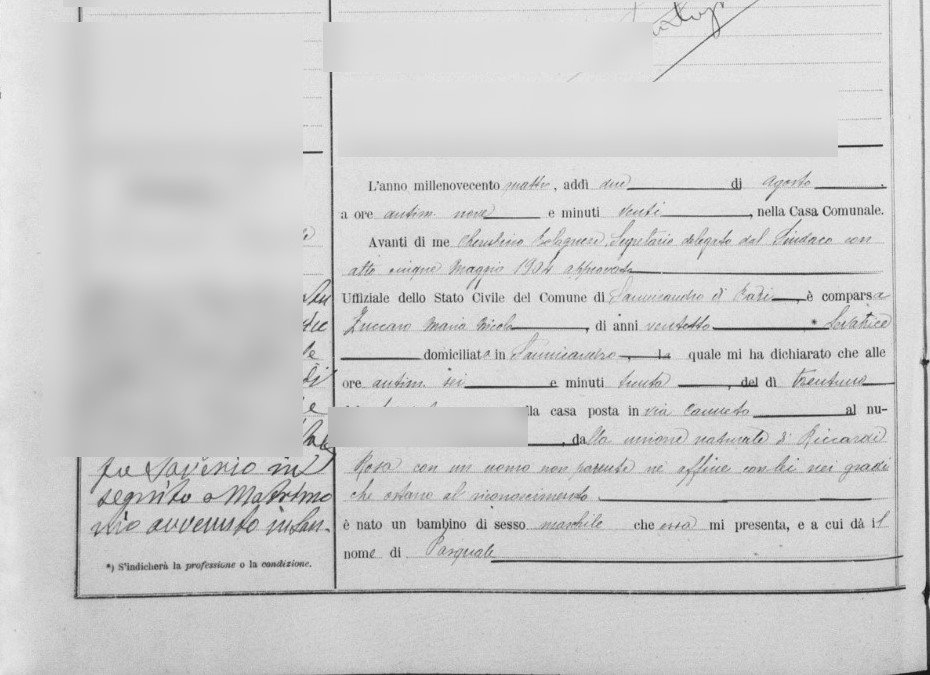
Some records have been digitised but not indexed. Others can only be browsed image by image. Some series remain available exclusively in municipal or archival collections and therefore require a direct request or research on site. This is one of the reasons why identifying the correct Italian town is so important in genealogical research.
Italian birth records reveal more than a date of birth
An Italian birth record, or atto di nascita, normally provides the child’s name and information about the circumstances of the birth. But a complete historical birth record may reveal considerably more. Depending on the period and the form used, it can contain:
- The exact date and sometimes the time of birth
- The place or address where the birth occurred
- The father’s name, age, occupation and residence
- The mother’s name and sometimes her age and occupation
- The identity of the person who reported the birth
- Witnesses to the declaration
- Information concerning legitimacy or recognition of the child
- Later marginal annotations
These details can provide important clues about the social and economic circumstances of a family.
An address may make it possible to locate the family in census or population records. An occupation can distinguish between two men with the same name. A parent’s age can suggest an approximate year of birth and point towards an earlier generation. Even small details matter.
Marginal annotations can reveal what happened decades later
One of the most useful features of many Italian civil records is the presence of marginal annotations, known as annotazioni marginali. These notes were added to an existing record when another event affected a person’s civil status. A birth record might therefore contain a later annotation referring to a marriage, recognition, change of status or death. This means that a document created at the beginning of a person’s life can sometimes provide information about events that occurred many years later. Marginal annotations are one of the reasons Italian civil records can remain useful long after the original event was registered.
For genealogists, these annotations can create a direct bridge to another record. Instead of searching blindly for a marriage, for example, an annotation may provide the spouse’s name, the municipality and the date of the event. They should never be ignored simply because they appear in smaller handwriting at the edge of the page.
Marginal annotations can reveal what happened decades later
One of the most useful features of many Italian civil records is the presence of marginal annotations, known as annotazioni marginali. These notes were added to an existing record when another event affected a person’s civil status. A birth record might therefore contain a later annotation referring to a marriage, recognition, change of status or death. This means that a document created at the beginning of a person’s life can sometimes provide information about events that occurred many years later.
For genealogists, these annotations can create a direct bridge to another record. Instead of searching blindly for a marriage, for example, an annotation may provide the spouse’s name, the municipality and the date of the event. They should never be ignored simply because they appear in smaller handwriting at the edge of the page.
Marriage records can connect two entire families
An Italian marriage record is particularly valuable because it brings together information about two people and, frequently, their parents. A historical atto di matrimonio may include:
- The names of the bride and groom
- Their ages
- Their places of birth
- Their places of residence
- Their occupations
- Their marital status
- The names of their parents
- Whether their parents were living or deceased
- The names of witnesses
For genealogical research, the places of birth are often especially important. A couple may marry in one municipality even though one or both spouses were born somewhere else. Their marriage record can therefore reveal the precise town needed to continue the research. This can completely change the direction of a family history investigation.
The record behind the marriage may be even more valuable
The marriage act itself is not always the most informative document connected with a marriage. Before a marriage could take place, the couple often had to provide documentation proving that the legal requirements had been satisfied. Depending on the period and location, these papers may survive as allegati or processetti matrimoniali. They can include copies or extracts of birth or baptism records, death records of parents or previous spouses, marriage publications, consent documents and other supporting papers.
For a genealogist, a surviving marriage file can be an exceptional discovery because it may contain evidence relating to several generations within a single group of documents. This is why searching only for the marriage act can sometimes mean overlooking the most valuable part of the surviving documentation.
Death records can identify an earlier generation
Death records are sometimes underestimated. Researchers often approach them simply to establish when an ancestor died. Yet a historical Italian death record may provide information useful for reconstructing the person’s entire life. It may contain:
- The person’s age
- Occupation
- Residence
- Place of birth
- Name of the spouse
- Names of the parents
- Information concerning whether the parents were already deceased
- The people who reported the death
When the parents are named, the record may provide the link needed to move the family tree another generation backwards. There is, however, an important genealogical consideration.
The information in a death record was normally supplied by people other than the deceased. Their knowledge could be incomplete, particularly when the person who died had been born in another town many decades earlier. A birth record is therefore usually stronger evidence for a person’s birth than information reported at the time of death.
Genealogical research requires comparing sources rather than treating every statement in a document as equally reliable.
Occupations tell part of the family’s story
Occupations appear frequently in Italian civil records and should not be treated as decorative information. Terms such as contadino, bracciante, calzolaio, possidente, filatrice or domestica can provide clues about a family’s economic circumstances and social environment. Following occupations through several records can also reveal change.
A man described as a labourer when his first child was born may later appear as a landowner or shopkeeper. Members of the same extended family may repeatedly practise the same trade. Occupational information can also help distinguish people who share the same name in the same village. In small Italian communities, where the same combinations of first names and surnames can appear repeatedly, these details can be essential.
Addresses can reconstruct the geography of a family
Historical records frequently identify a street, hamlet or part of a municipality where a family lived. Addresses recorded in Italian civil records can also help reconstruct family movements within a town or province.
This information can be valuable for more than locating an ancestral house. Addresses can reveal that several related families lived close to one another. They can help distinguish households with identical surnames. They can also guide research towards population registers, property records, parish registers and other local sources. In rural communities, a locality or frazione may be particularly significant.
The municipality written on an American immigration document may therefore be only part of the story. The family might actually have lived in a small village, hamlet or isolated locality within its territory. Understanding the historical geography of the area can be just as important as reading the names in the register.
Witnesses and declarants should not be ignored
Witnesses are often skipped when researchers transcribe civil records. That can be a mistake.
The people appearing as witnesses or declarants may be relatives, neighbours, colleagues or other members of the family’s local network. One witness may later appear as a brother in another document. A person reporting a death may turn out to be a son in law. The same surnames may recur repeatedly among neighbouring families. These connections become particularly valuable when direct evidence is missing.
Genealogical research is not only about collecting ancestors. It is also about reconstructing the community around them.
Names are not always as simple as they appear
Italian ancestors can appear under slightly different names from one record to another. A person recorded with several given names at birth may use only one of them later in life. Spelling can vary. Handwriting may be difficult to interpret. Foreign records may contain anglicised versions of Italian names. Surnames may also have been written differently by different officials. For this reason, a discrepancy does not automatically mean that two records concern different people. Dates, occupations, parents, spouses, addresses and witnesses all have to be considered together. The document must be analysed in context.
Not every Italian civil record is online
One of the most common misconceptions in Italian genealogy is that if a record cannot be found online, it does not exist. That is not the case. Digitisation differs enormously between archives and municipalities. Many Italian civil records still require research beyond searchable online databases.
A record may exist but not yet be digitised. A register may be online but not indexed. A useful supplementary series may never have been uploaded. The relevant documents may still be held by a municipality, State Archive or another local institution.
The Portale Antenati itself contains many different types of civil registers, including births, marriages, deaths, marriage publications and supplementary documentation, depending on the archive and locality. FamilySearch collections can also contain records beyond the basic birth, marriage and death series. In the Milan collections, for example, available material includes marriage publications, supplementary documents, indexes and other civil registration material.
Knowing where the record should be kept is therefore as important as searching for a name.
Finding the record is only the beginning
The real value of an Italian civil record lies in the questions it allows us to ask next.
- Where were the parents born?
- Did the family move between municipalities?
- What did they do for a living?
- Were earlier generations already deceased when the marriage occurred?
- Can the marriage documentation identify the grandparents?
- Does an annotation lead to another event?
- Are there parish records that can extend the family line further back?
- Can military, notarial or population records add another layer to the family’s history?
This is where a certificate becomes genealogical research. Instead of collecting isolated dates, the objective is to connect documents and reconstruct the lives behind them.
Researching Italian civil records professionally
Historical Italian civil records are among the richest sources available for reconstructing Italian families, but their value depends on careful interpretation. A single birth, marriage or death record may provide enough information to identify another municipality, another archive or another generation. In other cases, the decisive information is not contained in the main record at all, but in an annotation, an attachment or another archival series.
As a professional genealogist based in Italy, I research civil, parish and archival sources both online and directly in Italian archives and municipalities. My work includes identifying the correct records, interpreting historical documents and following the evidence into additional sources when the family’s story cannot be reconstructed from online databases alone. Reading Italian civil records correctly means looking beyond names and dates and understanding how each detail connects to other sources.
If you are researching an Italian ancestor and have reached a point where the available records are incomplete, difficult to interpret or not available online, I can help identify the next source and continue the research in Italy.
