
And What You Can Do When Your Search Suddenly Stops
If you are searching for Italian genealogy records not online, the first step is understanding where those records may be preserved in Italy.
Many people contact me after spending weeks, sometimes months, searching for an Italian ancestor online. They have checked FamilySearch, Antenati, Ancestry, MyHeritage and every possible spelling of the surname. They have searched by date, by town, by parents’ names, by immigration records, and sometimes even by guessing.
- And What You Can Do When Your Search Suddenly Stops
- Why Are Italian Genealogy Records Not Online?
- Not Finding a Record Online Does Not Mean It Is Lost
- Why Italian Records Are So Local
- Common Types of Italian Genealogy Records and Where They May Be Found
- Civil Records Are Not Always Available Online
- Parish Records Are Often the Key
- Indexes Can Be Wrong
- Surnames and Place Names May Have Changed Abroad
- The Problem May Be the Town, Not the Record
- What to Do When Online Research Stops
- When Research in Italy Becomes Necessary
- Italian Genealogy Goes Beyond Databases
- Frequently Asked Questions About Italian Genealogy Records
- Are all Italian birth records online?
- Why can I find one ancestor online but not another?
- Are Italian parish records available online?
- Does a missing online record mean the record was destroyed?
- What should I do if I cannot find my Italian ancestor online?
- Can I request Italian records directly from the Comune?
- Why is the exact Italian town so important?
- Need Help Finding Italian Records That Are Not Online?
- Have you searched online without finding your Italian ancestor?
Italian genealogy records are often more complex than they appear because they were created and preserved by many different local institutions.
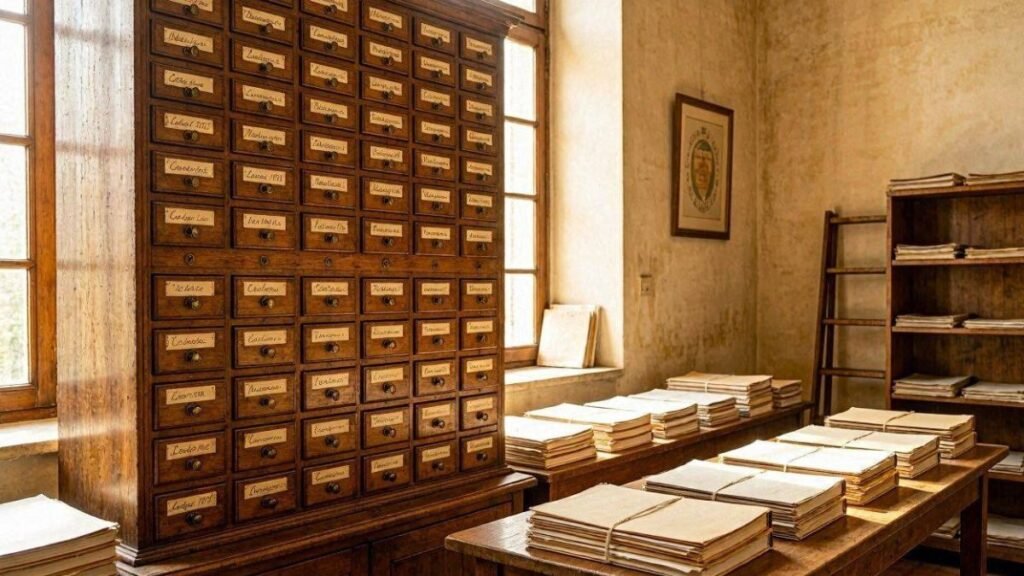
Then, at some point, the search stops. The ancestor is not there, the year is missing, the town is not indexed, or the record appears to have disappeared.
In many cases, however, the problem is not that the record no longer exists. The problem is much simpler: the record is not online.
Why Are Italian Genealogy Records Not Online?
Italian genealogy records are often not online because many civil, parish and historical records are still preserved locally in municipal archives, parish churches, diocesan archives or local historical collections. Some records have never been digitized. Some have been digitized but not indexed. Others can only be requested from the Italian Comune, parish or archive that preserves the original register.
This is one of the most important things to understand when researching Italian ancestry. Online databases are useful, but they are only part of the story. Italian genealogy often begins online, but it does not always end there.
Not Finding a Record Online Does Not Mean It Is Lost
One of the most common misunderstandings in Italian genealogy is the idea that if a record is not online, it probably does not exist. That is rarely the right conclusion.
In Italy, many records are still kept locally. A birth act may be preserved in a Comune, a baptism may be written in a parish register, a marriage file may be stored in a municipal archive, and a death record may exist only as part of a register that has not been scanned or indexed.
Sometimes the record is online, but the index is incomplete. Sometimes the images are available, but the name was transcribed incorrectly. Sometimes the town is wrong. Sometimes the family used one version of the surname in Italy and another abroad.
This is why Italian genealogy often requires a different approach from simple online searching. You are not only looking for a name in a database. You are trying to reconstruct where the record was created, who created it, where it is preserved today and how it can be accessed.
Why Italian Records Are So Local
Italian records were not created as one national genealogical system. They were created by local institutions: municipalities, parishes, dioceses, military districts, courts, notaries and administrative offices. Each place had its own registers, its own procedures and, in many cases, its own history of preservation.
This is why the exact town matters so much. If an ancestor was born in “Naples”, that may not mean the city of Naples. It could mean a smaller municipality nearby, or simply the place the family used abroad because it was easier to recognize. The same happens with Palermo, Milan, Rome, Genoa, Bari, Salerno and many other large cities.
For Italian research, “from Naples” is not always enough. The real question is: which Comune? Which parish? Which archive?
A family may have always said that an ancestor came from Naples, but the birth record may be in Castellammare di Stabia, Portici, Torre del Greco, Somma Vesuviana or another nearby town. A person described as being from Milan may actually have been born in a smaller municipality in the province. A Sicilian ancestor may have given only the name of the island, while the actual records are preserved in one specific town.
Italian genealogy depends on local precision.
Common Types of Italian Genealogy Records and Where They May Be Found
| Record type | Usually online? | Where it may be preserved |
|---|---|---|
| Birth records | Sometimes | Comune, State Archive, Antenati |
| Marriage records | Sometimes | Comune, State Archive, parish archive |
| Death records | Sometimes | Comune, State Archive, parish archive |
| Baptism records | Less often | Parish archive or diocesan archive |
| Burial records | Less often | Parish archive |
| Military records | Partly | State Archive or military district |
| Population registers | Rarely | Municipal archive |
| Notarial records | Rarely | State Archive |
| Parish status animarum | Rarely | Parish or diocesan archive |
This is why two families with Italian ancestry may have completely different research experiences. One person may find several generations online in a few hours. Another may need direct archival research after only one generation.
Civil Records Are Not Always Available Online
Civil registration is one of the main sources for Italian genealogy. Birth, marriage and death records can provide names, ages, occupations, addresses, parents’ names and sometimes important marginal notes.
But civil records are not equally available everywhere. Some Italian towns have excellent online coverage. Others have only partial collections. Some records are available up to a certain year and then stop. Some are online as images but not indexed. Others are not online at all.
This can happen for many reasons. A register may never have been digitized, a collection may be incomplete, some years may be missing, or certain records may still be held by the local municipality. More recent records may be subject to access restrictions. In other cases, documents may have been damaged or lost because of war, humidity, fire, poor conservation or administrative transfers.
This is especially important for people looking for official records for Italian dual citizenship. A record useful for family history may sometimes be found online, but an official certificate or certified copy usually has to be requested from the Italian Comune, parish or archive that preserves the original documentation.
For this reason, Italian genealogy records must usually be searched town by town, not only through broad online databases.
Parish Records Are Often the Key
When civil records are not enough, parish records often become essential. Before civil registration, births, marriages and deaths were usually recorded by the Church. Baptism, marriage and burial registers can take a family line back into the eighteenth, seventeenth or sometimes even sixteenth century, depending on the parish and the survival of the books.
But parish records are much less likely to be online. Many are still preserved in local parish archives or diocesan archives. Some have never been digitized. Some can be consulted only by appointment. Some require permission. Some are fragile and cannot be photographed freely. Others are accessible, but only if the request is precise enough.
Many Italian genealogy records before civil registration are actually parish records, especially baptisms, marriages and burials.
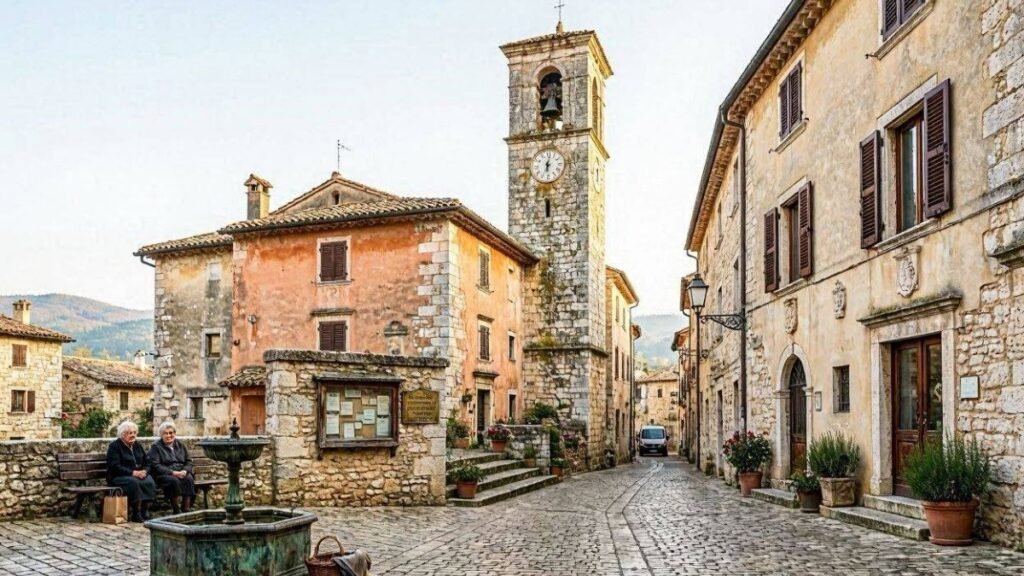
Parish records also require specific skills. They may be written in Latin, in old Italian, or in a mixture of formal ecclesiastical language and local habits. The handwriting can be difficult. Names may appear in Latin forms. Surnames may vary. A priest may write a surname one way in a baptism and another way in a marriage record twenty years later.
For example, Giovanni may appear as Joannes. Giuseppe may appear as Joseph or Josephus. Domenico may appear as Dominicus. A woman named Maria may appear with additional devotional names that do not always appear in civil documents. This is one reason why simply typing a name into a search field is often not enough.
Indexes Can Be Wrong
Online indexes are helpful, but they are not perfect. Many Italian records were handwritten in old scripts. Some were damaged. Some were written quickly by clerks or priests. Others contain abbreviations, Latin forms or local spelling habits that are difficult even for trained readers.
When those records are indexed, mistakes happen. A surname may be misread, a place name may be misunderstood, a date may be entered incorrectly, a child’s name may be confused with the father’s name, a marginal note may be ignored, or a record may be indexed under a spelling that the family never used abroad.
This is very common. For this reason, it is always better to examine the original image whenever possible. The index is a tool, not the final proof. In professional genealogy, the original record matters more than the searchable result.
Surnames and Place Names May Have Changed Abroad
Another difficulty is that many Italian names changed after emigration. Sometimes the change was formal. Sometimes it was only a spelling variation. Sometimes it was the result of pronunciation, transcription or adaptation to another language.
An Italian surname may appear differently in American, British, Canadian, Australian or South American records. A passenger list may contain an error. A census record may simplify the name. A naturalization file may preserve a version that is close, but not identical, to the original Italian form.
The same happens with place names. Foreign documents often contain distorted Italian towns. A clerk may have written what he heard. A family may have used the nearest famous city instead of the real town. A place name may be misspelled so badly that it becomes almost unrecognizable.
This is why foreign records must be used carefully. They are often essential, but they need to be compared with Italian geography and archival logic.
The Problem May Be the Town, Not the Record
When a record cannot be found, the first question should not be “is the record lost?” The first question should be “are we looking in the right place?”
This is especially true when the only known place of origin comes from family memory, an immigration document or a death certificate abroad. Death certificates, in particular, can be unreliable for Italian birthplaces. The informant may have been a child, a spouse, a neighbor or someone who did not know the exact details. The town may be missing, approximate or confused with a province.
Naturalization records and marriage records are often more useful, but even they can contain errors. Before contacting an Italian Comune, it is important to collect every possible clue from records created in the country of immigration. A precise town, a parent’s name, a spouse’s name or a date of birth can make the difference between a successful request and a dead end.
What to Do When Online Research Stops
If your Italian genealogy research stops online, do not assume that you have reached the end. The next step is to rebuild the evidence.
Start with the most recent confirmed person and work backward. Gather every document you already have. Compare names, dates, places and family members. Look for contradictions. Pay attention to witnesses, addresses, occupations and marginal notes.
Useful sources outside Italy may include naturalization files, passenger lists, marriage certificates, death certificates, census records, military records, obituaries, cemetery records, church records and family papers. The goal is to identify the exact Italian town or at least reduce the possibilities.
Once the correct town is identified, the research can move to Italian sources: civil records, parish registers, municipal archives, diocesan archives, military records, notarial records and local historical collections. At that point, the research becomes less about searching online and more about knowing where to ask, what to ask for and how to read the answer.
When Research in Italy Becomes Necessary
Professional research in Italy becomes useful when the available online records are not enough. This may happen when the town is uncertain, when the records stop before the year you need, when parish registers are required, when the handwriting is difficult, when the surname has variations, or when official certificates are needed for legal or citizenship purposes.
It is also useful when a Comune does not answer, when a parish request must be written precisely, or when the records can only be consulted in person.
In my work as a genealogist based in Italy, I often deal directly with municipal archives, parish offices and diocesan archives when online databases are incomplete. In many cases, the most important record is not missing. It is simply preserved in a place that cannot be searched with a name field.
A genealogist based in Italy can identify the right archive, verify whether records exist, contact local offices, examine original registers, read old handwriting and reconstruct the family line through documentary evidence. This is not only about finding names and dates. It is about understanding how Italian records were created and how they are preserved today.
Italian Genealogy Goes Beyond Databases
Online genealogy has made Italian family history research easier in many ways. It allows people all over the world to begin discovering their roots from home.
But Italy still holds an enormous amount of historical documentation offline. Many records remain in municipal offices, parishes, diocesan archives and local repositories. Some have never been digitized. Some are not indexed. Some require formal requests. Others can only be understood by reading the original register page by page.
So if you cannot find your Italian ancestor online, the search may not be over. It may simply be time to move from databases to archives.
Frequently Asked Questions About Italian Genealogy Records
Are all Italian birth records online?
No. Many Italian birth records are online, but coverage depends on the town, province, period and archive. Some towns are well represented in digital databases, while others have only partial records or no online records at all.
Why can I find one ancestor online but not another?
Italian records were preserved locally, and online coverage varies from town to town. One branch of your family may come from a municipality with digitized records, while another may come from a place where the records are still only available in the local archive or parish.
Are Italian parish records available online?
Sometimes, but not always. Many Italian parish records are still preserved in parish or diocesan archives and have never been digitized. They may require a direct request or in person consultation.
Does a missing online record mean the record was destroyed?
No. A missing online record does not necessarily mean that the record was destroyed. It may still exist in a municipal archive, parish archive, diocesan archive or local historical collection.
What should I do if I cannot find my Italian ancestor online?
Start by confirming the exact town of origin. Then check whether civil records, parish records, military records or municipal archive records are available for that place and time period. If the records are not online, professional research in Italy may be necessary.
Can I request Italian records directly from the Comune?
In many cases, yes. However, the request must usually be precise. You should provide the full name, date or approximate year, place, parents’ names if known, and the reason for the request. Some municipalities respond quickly, while others may require follow up or additional documentation.
Why is the exact Italian town so important?
Italian records are usually organized by Comune or parish. Knowing only the province or region is often not enough. To find a birth, marriage, death or baptism record, it is usually necessary to identify the specific town where the event took place.
Need Help Finding Italian Records That Are Not Online?
If you have searched online and cannot find your Italian ancestor, Italian Roots Research can help you understand where the search should continue.
I provide genealogical research in Italy, civil and parish record searches, transcription and translation of historical documents, and on site archival research when records are not available online.
Many Italian family stories begin with a name in a foreign document. The real discovery often begins when that name is traced back to the town, the parish and the original record in Italy.
When Italian genealogy records cannot be found online, the next step is often to identify the local archive, parish or municipality that may still preserve them.
Have you searched online without finding your Italian ancestor?
Many Italian records are still preserved in local archives, parishes or municipalities. If your research has reached a dead end, I can help you understand where to look next. In many cases, Italian genealogy records not online can still be found through municipal archives, parish offices, diocesan archives or direct research in Italy.
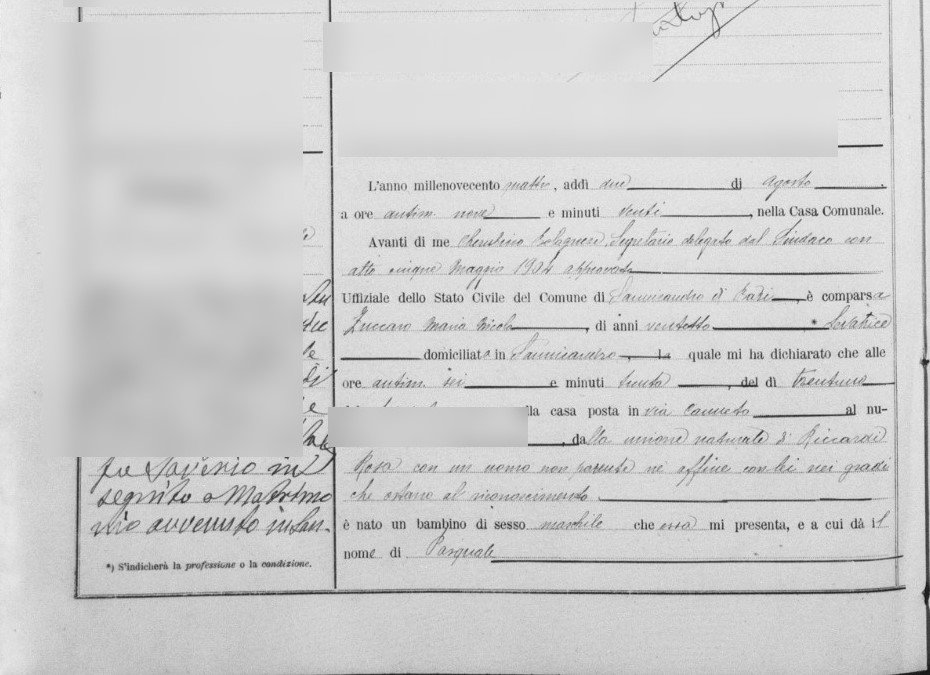
What Italian Civil Records Can Reveal About Your Ancestors
When researching an Italian ancestor, finding a civil record is often treated as a simple…
Italian Genealogy Records Not Online: Why It Happens and What to Do
And What You Can Do When Your Search Suddenly Stops If you are searching for…
Cost of Genealogy Research in Italy
Many people exploring their family history eventually wonder about the cost of genealogy research in…
